

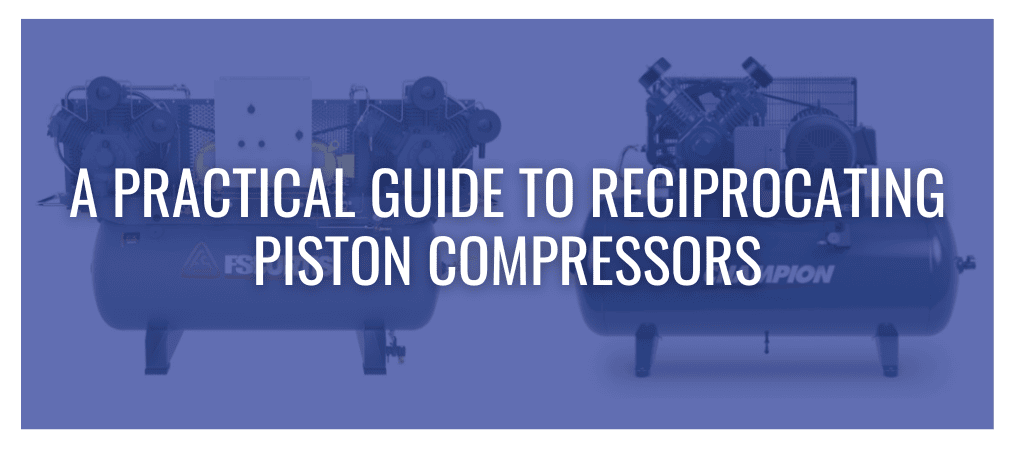
Reciprocating piston compressors are positive-displacement machines that use one or more pistons driven by a crankshaft to compress air and deliver it at higher pressure. They are workhorses in manufacturing, automotive, construction, and general industrial settings, valued for reliability, relatively low initial cost, and the ability to reach high output pressures.
How They Work
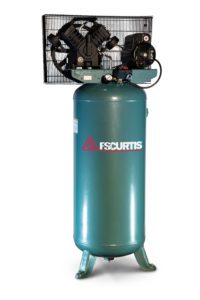
A motor drives a crankshaft, which moves one or more pistons back and forth inside cylinders. On the intake stroke, the piston pulls back and draws air in through a valve. On the compression stroke, the piston pushes forward, compresses the air, and forces it out through a discharge valve into a receiver tank.
That receiver tank stores pressurized air so the system can meet short bursts of demand without the motor cycling constantly. When pressure drops below a set threshold, the motor kicks back on. This is why piston compressors are described as intermittent-duty machines: built for work cycles, not 100% continuous operation.
Single-Stage vs. Two-Stage: What Is the Difference?
The stage count tells you how many times the air is compressed before it reaches the receiver tank.
In a single-stage unit, air is drawn in and compressed once, typically to pressures between 100 and 150 PSI. These work well for light-to-medium industrial tasks, automotive shops, and general fabrication.
In a two-stage unit, air is compressed in a first cylinder, cooled through an intercooler, and then compressed again in a second, smaller cylinder. This allows pressures up to 175 PSI or higher, with better efficiency at sustained loads. Two-stage reciprocating piston compressors are the right call when your operation needs higher pressure or more CFM output across longer run times.
The Compressed Air and Gas Institute (CAGI) notes that two-stage designs deliver measurably better efficiency at pressures above 100 PSI, making them a standard choice for facilities with sustained demand.
What Are Reciprocating Piston Compressors Used For?
These units appear across a wide range of industries. Common applications include:
- Automotive repair shops (pneumatic tools, tire inflation, painting)
- Metal fabrication and welding operations
- Food and beverage packaging (clean, dry air for product contact applications)
- Construction and contractor work with portable units
- Petrochemical and refinery operations requiring high-pressure delivery
How Do You Choose the Right Unit?
Selecting correctly starts with three numbers.
CFM (cubic feet per minute): Add up the CFM ratings of all the tools or processes you intend to run simultaneously, then size your compressor to exceed that total. Running a unit at or near its rated limit continuously shortens service life.
PSI: Match the compressor’s output pressure to your highest-pressure application. Sustained operation at the top of the pressure range adds unnecessary wear.
Duty cycle: Reciprocating piston compressors are typically rated for 50% to 75% duty cycles. If your operation demands more continuous output, a rotary screw compressor may be a better match. See the full product line at aircompressorcfm.com to compare options.
Request a consultation at aircompressorcfm.com/contact.
Maintenance Essentials
Deferred service shows up as unplanned downtime and accelerated wear. Consistent maintenance keeps reciprocating piston compressors running.
Change the oil on schedule. Most manufacturers specify oil changes every 500 to 1,000 hours. Running oil past its service interval accelerates wear on piston rings, bearings, and cylinder walls.
Drain the receiver tank daily. When the drain valve stops working properly, water builds up inside. Over time that moisture causes corrosion and degrades your air quality at the point of use.
Inspect valves regularly. Intake and discharge valves are the most common wear items on reciprocating piston compressors. A leaking or stuck valve reduces compression efficiency and forces the motor to work harder. A valve inspection every 1,000 hours is a reasonable baseline for most industrial applications.
Replace air filters. A clogged intake filter restricts airflow to the cylinders. The compressor still runs, but it works harder to move the same volume of air, raising operating temperatures and shortening the time between overhauls.
The U.S. Department of Energy estimates that a well-maintained compressed air system can reduce energy consumption by 20 to 50 percent (U.S. DOE Compressed Air Sourcebook). On an industrial compressor running every shift, that shows up on your energy bill.
Review APEC’s service and parts options at aircompressorcfm.com/compressor-parts.
FAQ
A reciprocating piston compressor is a positive-displacement machine that uses pistons, driven by a crankshaft, to compress air inside cylinders and deliver it at higher pressure to a receiver tank.
With proper maintenance, a well-built unit can last 10 to 15 years or more in industrial service. Compressors that run at excessive duty cycles or go without regular oil changes tend to fail significantly sooner.
Reciprocating piston compressors use pistons in cylinders and are best suited for intermittent-duty applications and higher output pressures. Rotary screw compressors use interlocking helical screws, are designed for continuous-duty industrial use, run quieter, and generally require less maintenance per hour of operation.
Yes. Oil-free models use PTFE-coated rings and other materials to keep lubricating oil out of the compression chamber. They are common in food processing, pharmaceuticals, and any application where air purity is a firm requirement.
Total the CFM requirements of all tools or processes you will run simultaneously at peak, then add a 25 to 30 percent buffer to avoid running the compressor at its rated limit continuously.
Talk to an Air Compressor Expert
Getting the most from reciprocating piston compressors starts with proper selection and a consistent service plan. Air Power Equipment Company has served industrial and commercial customers in Oklahoma City and across the region for decades. Whether you are sizing a new unit, troubleshooting an existing system, or scheduling preventive maintenance, the APEC team is ready to help. Contact us at aircompressorcfm.com or call today to talk through your compressed air needs.