


A rotary vane compressor and a rotary screw unit are not interchangeable. Both handle continuous industrial loads, but differ in design, application fit, and long-term cost. For quality-sensitive or moderate-demand work, the rotary vane is the stronger choice. Above 75 HP, the rotary screw scales better.
What Is a Rotary Vane Compressor?
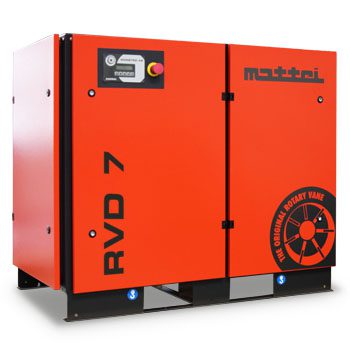
A rotary vane compressor uses a rotor with spring-loaded vanes mounted off-center inside a cylindrical housing. As the rotor spins, centrifugal force pushes the vanes outward against the housing wall. The space between each pair of vanes shrinks as the rotor turns, compressing the trapped air.
Fewer moving parts means fewer failure points. These units run quietly, typically in the 60 to 65 dBA range, and deliver consistent pressure with very low pulsation. Oil-injected configurations are most common in industrial settings: the oil lubricates the vanes, seals the compression chamber, and carries heat away.
How Does a Rotary Screw Compressor Compare?
A rotary screw compressor uses two intermeshing helical rotors that trap air between the lobe geometry and the housing as they turn. The trapped volume shrinks toward the discharge end, compressing the air. Rotary screws dominate industrial compressed air, are available in a wide HP range, and carry a mature service ecosystem.
Where the two designs differ: screw units carry slightly higher pulsation, more complex internal geometry, and in most cases a higher acquisition cost at equivalent output. They scale in ways rotary vane units do not, and their service infrastructure is more widely available.
Which Applications Favor Each Type?
The rotary vane compressor earns its place where smooth, pulsation-free air matters. Spray painting, food and beverage processing, packaging lines, and medical applications all benefit from that consistent output.
Rotary vane units are a strong fit for smaller-footprint installations, typically 5 to 75 HP. If your demand is moderate, continuous, and quality-sensitive, you should look into a rotary vane compressor.
High-demand environments favor rotary screw technology. Manufacturing plants, heavy fabrication shops, and facilities running multiple air-driven tools simultaneously are prime rotary screw territory. Variable-speed drive (VSD) models recover cost through energy savings when demand fluctuates.
What Does Total Cost of Ownership Actually Look Like?
Purchase price is one line item. Operating cost over five to ten years of actual use is where the real number lives.
Rotary vane units have lower internal complexity, which generally means lower maintenance cost per interval. Vane replacement is the primary wear item and is a straightforward maintenance service. The Compressed Air and Gas Institute (CAGI) publishes standardized performance data for both technologies so you can compare units on a normalized basis before you buy.
Rotary screw compressors typically carry higher parts costs for major service intervals. VSD models can offset that through energy savings if your demand is variable. That efficiency gap makes the choice between technologies a financial decision, not just a specs exercise.
How Do You Choose Before You Commit?
Start with your actual CFM demand. Know your peak, average, and minimum load, then size to real numbers. Oversizing wastes capital, and undersizing results in production downtime.
Next, consider air quality. Finish work, food contact, and medical applications require pulsation-free output. Rotary vane units deliver that consistently, and rotary screw units do not.
Finally, map your load profile across a full shift. Demand that varies significantly favors a VSD model. The DOE Compressed Air Systems guidance is a practical reference for working through those numbers.
If you are unsure where your operation falls, a compressed air audit can quantify your actual demand before you commit to a specific unit type.
Once you have answered those questions, APEC’s compressor specialists can review your specs and give you a clear, application-specific starting point.
Frequently Asked Questions
Smooth, pulsation-free output at moderate CFM and pressure levels. Automotive finishing, food and beverage processing, packaging lines, and medical applications are the most common use cases.
Neither is universally better. Rotary vane performs well in quality-sensitive, moderate-demand applications. Rotary screw units scale more effectively for high-demand environments above 75 to 100 HP. The right choice depends on your CFM requirements, application type, and total cost of ownership.
With proper maintenance intervals, rotary vane units can reach 80,000 hours or more of service life, per manufacturer specifications. Vane replacement is the primary wear service; following the manufacturer’s maintenance intervals is the main factor in achieving that service life.
Routine maintenance includes oil and filter changes, vane inspection and replacement at manufacturer-specified intervals, inlet filter service, and separator element replacement. OSHA compressed air safety standards require periodic safety valve inspections on any pressurized system.
Yes. These units are designed for continuous duty. They generate less heat than piston compressors and handle full production shifts without interruption.
Air Power Equipment Company has served industrial and commercial customers across Oklahoma City and the surrounding region since 1979. Whether you need help selecting the right rotary vane or rotary screw compressor for your application, or you’re ready to schedule service, the APEC team is ready. Contact APEC at aircompressorcfm.com or call 405-445-1216.