
Most body shop owners get their body shop air compressor sizing wrong. Too small, and you’re watching paint jobs fail mid-spray. Too large, and you’ve overspent on a machine that idles half the day. Getting the number right before you buy saves you from downtime, rework, and a second purchase you shouldn’t have needed.
Why Body Shop Air Compressor Sizing Matters
Your body shop’s efficiency depends on consistent, uninterrupted air pressure. Undersize your body shop air compressor, and you’ll face fluctuating PSI during peak spray operations, which can affect paint quality and frustrate technicians. Oversize it, and you waste energy and capital on equipment you’ll never fully utilize. Sizing it right keeps your operating costs and your downtime in check.
Body shop air compressors must deliver enough CFM (cubic feet per minute) to handle simultaneous tool use without pressure drops. A single HVLP spray gun can draw anywhere from 8 to 15+ CFM, depending on the gun and pressure setting. A body shop running multiple stations, sanders, and air-powered tools simultaneously can push total demand to 40 CFM or well beyond. That’s where most shop owners underestimate their actual needs.
How to Calculate Your Body Shop’s Actual Air Demand
Start by listing every air tool your shop will run simultaneously. Spray guns, sanders, impact wrenches, air chisels, grinders, and even simple air hoses for cleaning all consume CFM. Use each tool’s manufacturer specifications and resources like the CAGI compressor sizing guide to estimate simultaneous demand.
Here’s an example of what a mid-sized shop’s tool lineup might look like and the CFM each tool pulls:
- HVLP spray gun: 12–15 CFM at 90 PSI
- Rotary sander: 8–10 CFM
- Impact wrench: 5–7 CFM
- Air chisel or needle scaler: 4–6 CFM
- Miscellaneous cleaning and hand tools: 5 CFM
As an example, three technicians running spray guns, sanders, and impact tools at the same time could push peak demand to 35–45 CFM or higher, depending on the specific tools. Adding extra capacity for demand spikes, system losses, and future growth is standard practice when sizing a compressor system.
What PSI Do You Actually Need?
Many pneumatic shop tools are rated around 90 PSI, while spray gun requirements vary by model. Consistency matters more than absolute PSI. A quality air compressor should maintain steady pressure throughout a full shift without dropping below your tools’ minimum operating threshold.
For systems supporting tools rated around 90 PSI, make sure the compressor can deliver the required CFM at that operating pressure, even during peak demand. This is where tank size and pump capacity both matter. CAGI recommends considering demand, pressure, and air quality together when sizing a compressed air system.
Tank Size and Receiver Capacity
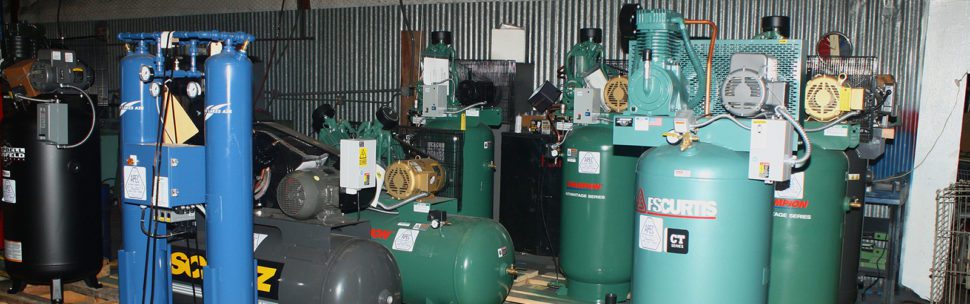
Tank size alone doesn’t determine your body shop air compressor’s CFM output. Think of the tank as a buffer, not the source. A larger tank stores more compressed air and allows a smaller pump to meet demand briefly, but if your compressor’s pump can’t produce enough CFM continuously, you’ll still experience pressure drops.
For many mid-sized body shops, receiver size should reflect compressor controls, demand patterns, and how much stored air the system needs to handle peaks without short-cycling. Receiver sizing should be based on actual system demand rather than simple rules of thumb. Pair it with a pump capable of delivering your peak CFM at rated PSI. Many body shops use rotary screw compressors in the 7.5–15 HP range, but horsepower should never be used as the primary sizing metric. Match the compressor’s rated CFM at your required PSI to your calculated peak demand.
Rotary Screw vs. Reciprocating Compressors
Rotary screw compressors are a common choice for busy body shops. They are well-suited to continuous operation and deliver consistent airflow with minimal pulsing.
Reciprocating compressors are often less expensive upfront but are generally better suited to intermittent rather than continuous-duty use. For smaller shops with lighter air demand, they can still be a practical option.
FAQ: Common Questions About Body Shop Air Compressors
You could, but plan for inefficiency and frustration in the meantime. A slightly oversized compressor from the start is often more economical than two purchases.
CFM is cubic feet per minute at any condition; SCFM is standard cubic feet per minute, measured at sea level, 68 degrees Fahrenheit, 36% humidity. SCFM is the standard you’ll see on spec sheets, so compare apples to apples.
For professional paint work, clean, dry compressed air is essential. Moisture, oil, and other contaminants can contribute to paint defects and finish-quality problems while also accelerating corrosion in pneumatic equipment. A properly sized dryer and filtration system helps protect both the finished product and your air system.
Follow the manufacturer’s preventive maintenance schedule. Change oil, check belts, inspect hoses, drain the tank, and service the dryer according to the equipment manufacturer’s recommended intervals.
It depends on the specific unit’s CFM output. Most portable compressors can’t sustain the continuous CFM a spray gun needs across a full panel, which leads to pressure drops mid-job. Check your spray gun’s CFM requirement against the compressor’s rated output before relying on a portable for production work.
Yes, with proper manifolding and line sizing. Central air compressor stations work well in larger facilities, but you need to confirm CFM and PSI hold at every distribution point. A professional assessment prevents undersizing the distribution system.
Sizing an air compressor correctly from day one saves your shop thousands in downtime, rework, and equipment replacement. Whether you’re setting up a new shop or upgrading from undersized equipment, expert guidance makes the difference. APEC has helped Oklahoma City body shops and industrial operations find the right body shop air compressor solution since 1979. Our team can assess your specific tool lineup, calculate your CFM demand, and recommend the right compressor and tank combination for your operation. Call APEC today for a no-pressure consultation, or visit our full product line online.