
Index of Topics
An undersized compressor can’t keep up with demand. An oversized one wastes energy and capital. Getting the industrial air compressor size right is one of the most important decisions you’ll make when purchasing industrial compressed air equipment, and it’s where many buyers make costly mistakes.
Whether you’re outfitting a new facility or replacing aging equipment, this industrial air compressor sizing guide will help you calculate what you actually need and avoid the most common pitfalls.
Start with CFM, Not Horsepower
The single most important number in industrial air compressor sizing is CFM (cubic feet per minute). CFM measures the volume of air the industrial air compressor delivers and directly determines whether your tools and equipment will get the air they need.
Horsepower (HP) indicates how much power the motor consumes, but two compressors with the same HP can deliver very different CFM ratings depending on design, efficiency, and configuration. According to the Compressed Air and Gas Institute, CFM at the required PSI is the proper specification for sizing.
How to Calculate Your Facility’s CFM Requirements
- List every air-powered tool and piece of equipment in your operation.
- Record each item’s CFM requirement at operating pressure (usually 90 PSI).
- Apply a diversity factor — not everything runs simultaneously. Most facilities multiply the total by 0.6–0.8 to account for actual usage patterns.
- Add 20–30% for future growth. Buying too tight means upgrading sooner than planned.
For example: if your tools total 120 CFM at 90 PSI, a 0.7 diversity factor yields actual demand of 84 CFM. Adding 25% for growth puts you at approximately 105 CFM — suggesting a 25–30 HP rotary screw compressor.
Understanding Duty Cycle
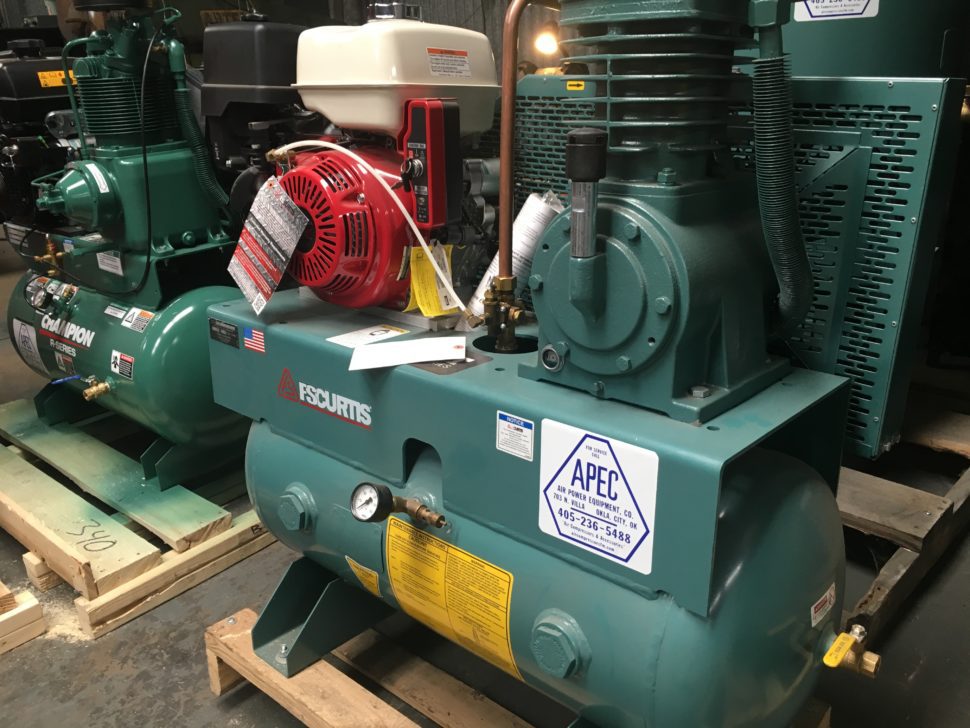 Not every industrial air compressor is designed to run continuously. The duty cycle tells you how long a compressor can operate before it needs to cool down.
- Reciprocating (piston) compressors typically have a 50–70% duty cycle — they run 30–42 minutes per hour and rest the remainder. They’re suited for intermittent use in auto shops, small manufacturing, and construction.
- Rotary screw compressors are designed for 100% continuous-duty operation. They’re the standard for manufacturing plants, processing facilities, and any application requiring a constant air supply.
If your facility needs compressed air for more than 6–8 hours per day, a rotary screw system is almost always the right choice. Running a reciprocating compressor beyond its duty cycle causes overheating, excessive wear, and premature failure.
PSI Requirements
Usually, an industrial air compressor will run at 90–125 PSI. Standard shop tools use 90 PSI, while some equipment requires 125 PSI or more. Your compressor’s rated PSI must be at least equal to your highest-pressure tool.
As air travels from the industrial air compressor through piping, it loses pressure due to friction, leaks, and moisture separators. The U.S. Department of Energy estimates that a poorly designed distribution system can lose 20–30% of generated pressure. Account for this by selecting an industrial air compressor rated 10–15 PSI above your highest tool requirement.
Common Sizing Mistakes
Designing Around Peak Demand
If your facility hits peak CFM for 15 minutes per shift, you don’t need an industrial air compressor that delivers peak CFM continuously. A properly sized receiver tank can handle short demand spikes at a fraction of the cost.
Ignoring Leaks
The DOE estimates that compressed air leaks waste 20–30% of output in a typical industrial facility. An air audit before purchasing can reveal whether a “need for more air” is actually a leak problem — fixable at a fraction of the cost of a new industrial air compressor.
Buying on Horsepower Alone
Two 25 HP compressors can deliver 80 CFM and 110 CFM respectively. HP without CFM is meaningless for sizing. Always compare CFM at your required PSI.
Forgetting Air Treatment
Moisture, oil, and particulates must be removed from compressed air before it reaches sensitive equipment. Dryers, filters, and separators consume pressure and should be accounted for in your system design.
Getting Professional Help with Sizing
A quick online CFM calculator can give you a ballpark number, but industrial air compressor systems are complex enough that professional assessment pays for itself. APEC — Air Power Equipment Company provides facility assessments for Oklahoma businesses that include:
- Air demand analysis based on your actual equipment and usage patterns
- Evaluation of existing piping, storage, and distribution systems
- Energy cost calculations comparing different compressor configurations
- Recommendations from brands including Champion and FS Curtis
- Ongoing maintenance planning to protect your investment
A properly sized system cuts costs, minimizes downtime, and delivers the air your operation needs. Contact APEC to schedule a free facility assessment.
Frequently Asked Questions
Add up the CFM requirements for the tools you plan to run at the same time, then add 20–30% extra capacity for future growth and demand changes. Many auto and fabrication shops use compressors in the 10–25 HP range delivering 30–80 CFM at 90 PSI, but the right size depends on your tools, workload, and usage patterns.
It depends on usage. For continuous operation — 6 or more hours per day — a rotary screw compressor is usually the better fit because it is built for steady, efficient performance. A piston compressor can still be a good choice for intermittent use or lower CFM needs. The right option comes down to your duty cycle, air demand, and operating environment.
List every air tool’s CFM rating at operating pressure. Multiply the total by a diversity factor of 0.6–0.8 since not all tools run at once. Then add 20–30% for future growth. The result is your target CFM.
Insufficient air pressure causes tools to underperform and cycle irregularly. The compressor itself will overheat and wear prematurely from running at maximum capacity continuously.
Yes. APEC — Air Power Equipment Company provides free facility assessments for Oklahoma businesses, including air demand analysis, energy calculations, and equipment recommendations tailored to your operation. Contact us to schedule yours.
Air Power Equipment Company in Oklahoma City (OKC), is the leading source for new air compressor sales and used air compressor sales throughout the country. We specialize in rotary screw air compressor sales and reciprocal air compressor sales. Air Power Equipment Company is also the best source for industrial air compressor service and air compressor parts in Oklahoma. If you are looking for new air compressors, used air compressors, air compressor parts, or industrial air compressor service call Air Power Equipment Company OKC. We are experts with all brands of air compressor equipment and we are a stocking distributor of air compressor brands like FS Curtis Air Compressors, Champion Air Compressors, Campbell Hausfeld Air Compressors, Kellogg Air Compressors, American Air Compressors, Quincy Compressor and many more. Call us at 4052375312 – we have what you need, and at the best price you will find.