Index of Topics
If your job site has reliable power and never moves, an electric compressor probably works fine. Most operations in Oklahoma don’t fit that description.
Construction crews, oil and gas pads, pipeline jobs, agricultural operations — they go where the work is, not where the outlets are. Diesel air compressors are built for exactly that. This guide covers what you actually need to know before buying one: how to size it, what configuration fits your setup and how to avoid the mistakes that cost buyers money.
Why Diesel Air Compressors Still Dominate Industrial Worksites
It comes down to one thing: independence.
Diesel air compressors don’t need a power hookup. It doesn’t care about load restrictions or how far off the grid your job site is. You fuel it and it runs. Same output at hour one as hour eight. That consistency is what makes diesel the default on construction sites, oil field pads and heavy industrial applications across Oklahoma.
Electric units have gotten better, but they still require infrastructure. When you’re running jackhammers, pneumatic drills or sustained sandblasting on a remote site, you want a machine that doesn’t need babysitting. Diesel air compressors deliver that.
CFM vs. PSI: The Number Most Buyers Get Wrong
Here’s where a lot of buyers go wrong: they shop PSI and ignore CFM.
PSI measures pressure. CFM, cubic feet per minute, measures volume: how much air the compressor actually delivers. High PSI with low CFM starves your tools. If you’re running multiple pneumatic tools at once or anything that needs sustained high-volume airflow, CFM is the number you size around.
A rough guide by application:
- 185-400 CFM: General construction, light-to-medium drilling, utility work
- 400-900 CFM: Heavy drilling, refinery operations, high-demand job sites
- 900+ CFM: Large-scale industrial, specialized pipeline and high-pressure applications
Calculate your peak tool requirements and add a 25-30% buffer. Running diesel air compressors at or above rated capacity will shorten their life faster than almost anything else. The U.S. Department of Energy estimates that properly sized compressed air systems can cut energy costs by 20-50%. Worth the 20 minutes it takes to do the math upfront.
Not sure what you need? The team at APEC sizes diesel air compressors every day. Call them before you commit.
Portable, Towable, or Skid-Mounted?
Get this decision right before you buy, because configuration is harder to change than you’d think.
Towable (trailer-mounted)
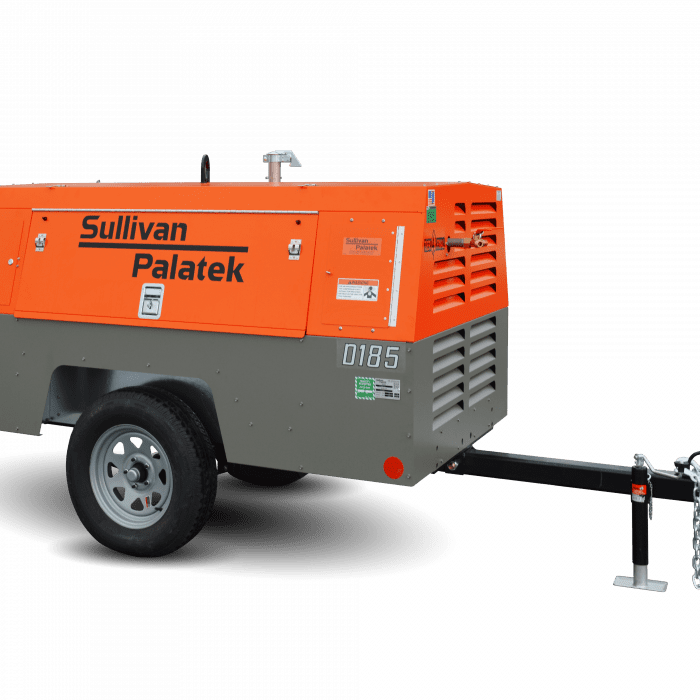 The most common setup for job sites that move. Hitch it to a truck and go. Most Oklahoma construction and utility crews run towable diesel air compressors in the 185-375 CFM range. View APEC’s diesel inventory for current options.
Skid-mounted
Right for fixed locations: a shop floor, a production facility, a compressor house and pad sites. You get a stable footprint and easier maintenance access. If your compressor isn’t going anywhere, skid-mount makes more sense than paying for a trailer.
Truck-mounted
Compact diesel air compressors that ride on a service truck. Popular with mobile mechanics and road crews who need air on demand without pulling a trailer. Less output than a towable, but you’re not dragging a second vehicle everywhere you go.
New vs. Used: Which Makes More Sense?
Both can be the right call. It depends on what you can’t afford to risk.
New diesel air compressors come with a full manufacturer’s warranty, current Tier 4 Final emissions compliance, and a service history that starts at zero. For operations where downtime means real money lost, the premium is worth it.
Used diesel air compressors can save you significantly on purchase price. The catch is that total cost of ownership depends almost entirely on maintenance history and hours logged. A low-hour unit with clean service records from a reputable dealer is a solid buy. A mystery machine with no paperwork is a coin flip at any price.
APEC stocks both new and inspected used diesel air compressors. Their service team can also look over a unit you’re sourcing elsewhere and tell you what you’re actually getting.
What to Ask Before You Buy
Five questions. Get clear answers to all of them before you sign anything.
- What CFM do I actually need at peak demand? List your tools, total the CFM, add 25-30% and don’t round down.
- Does my application require Tier 4 Final compliance? A lot of commercial job sites and government contracts do. Check before you buy, not after.
- What does the service network look like? A broken compressor on a job site is a very expensive problem. Know where parts and service come from before something goes wrong.
- What’s the duty cycle? Intermittent use and continuous operation aren’t the same machine. Match the spec to how you’ll actually run it.
- What are the real fuel costs at your expected runtime? Fuel economy varies a lot by brand and model. Run the numbers, not just the spec sheet.
Why Oklahoma Industrial Buyers Choose APEC
Since 1979, Air Power Equipment Company has been the go-to source for industrial compressed air equipment in Oklahoma. That’s not marketing copy. It’s a long time to be in one market, and the repeat business reflects it.
They stock diesel air compressors sized for construction, oil and gas and heavy manufacturing. Beyond the sale, APEC runs full-service maintenance and repair with factory-trained technicians who do on-site service across the state. Same-day emergency service is available when things break at the worst possible time.
Visit aircompressorcfm.com or call 405-445-1216 to talk through your application.
Interested in diesel air compressors for your operation? APEC has been putting the right equipment on Oklahoma job sites since 1979. Visit aircompressorcfm.com or call 405-445-1216 to get started.
Frequently Asked Questions
For most Oklahoma construction jobs, a towable unit in the 185-375 CFM range handles the majority of tasks. Quincy and FS Curtis are both solid options with good local support through APEC in OKC.
New industrial diesel units typically run $15,000 on the low end to $80,000 or more for large high-CFM models. Used equipment can save you real money if the service history checks out.
Yes. Oil changes, air and fuel filter replacements and regular inspection of belts, hoses and cooling systems. Stay on the manufacturer’s schedule. A preventative maintenance plan through APEC is the easiest way to make sure it gets done.
For short-term projects or CFM ranges you don’t use often, rental can make more financial sense than buying. Talk to APEC about your timeline and they’ll tell you which way pencils out better.
It’s the EPA’s toughest emissions standard for diesel engines. A lot of commercial job sites and government contracts won’t allow non-compliant equipment. New inventory at APEC meets this standard.
APEC, Air Power Equipment Company, is the OKC area’s primary source for industrial diesel compressors. New and used inventory, full service support and staff who know the equipment. Visit aircompressorcfm.com or call 405-445-1216.
Air Power Equipment Company in Oklahoma City (OKC), is the leading source for new air compressor sales and used air compressor sales throughout the country. We specialize in rotary screw air compressor sales and reciprocal air compressor sales. Air Power Equipment Company is also the best source for industrial air compressor service and air compressor parts in Oklahoma. If you are looking for new air compressors, used air compressors, air compressor parts, or industrial air compressor service call Air Power Equipment Company OKC. We are experts with all brands of air compressor equipment and we are a stocking distributor of air compressor brands like FS Curtis Air Compressors, Champion Air Compressors, Campbell Hausfeld Air Compressors, Kellogg Air Compressors, American Air Compressors, Quincy Compressor and many more. Call us at 4052375312 – we have what you need, and at the best price you will find.